

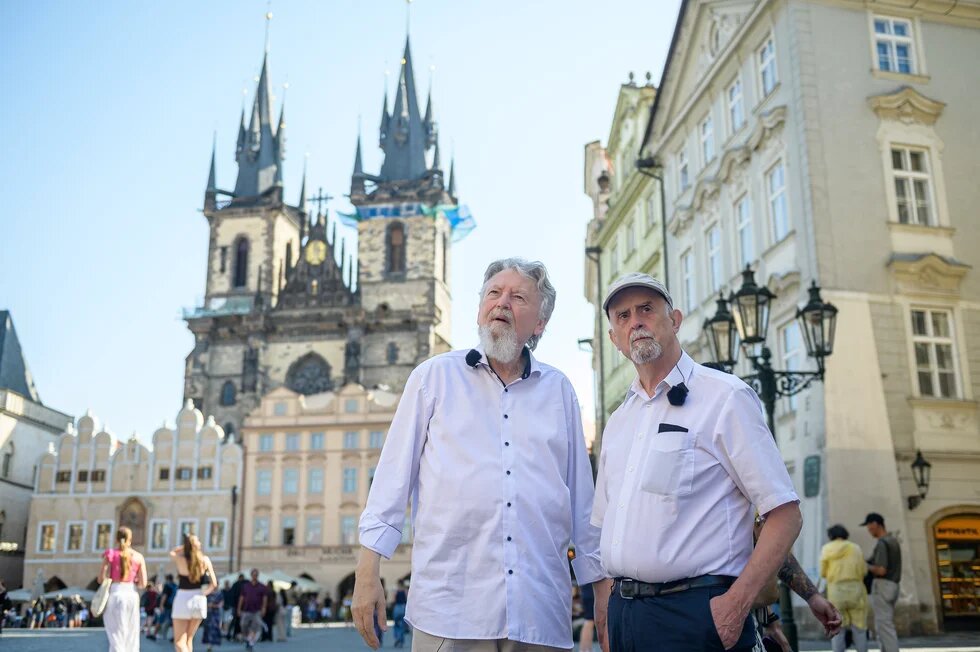
He was 20 years old, photographing occupied Prague in August 1968, when a Soviet soldier tried to confiscate his camera, which he refused to let him have. The soldier pointed his machine gun right at the chest of René Böll, son of German author Heinrich Böll, future winner of the Nobel Prize for literature.

Roma civilians intervened in the tense situation on the Old Town Square. According to eyewitness testimonies, a young Romani woman pushed the barrel of the weapon aside and aided the prevention of a tragedy.
The Heinrich-Böll-Stiftung Foundation published an account of the incident on the 2018 anniversary of the invasion. Heinrich Böll had come to Prague with his wife Annemarie and his son René on 20 August 1968 just a few hours before the Warsaw Pact troops’ invasion started.
The German author wanted to personally witness the reform process of the Prague Spring, in which he had invested great hope. Instead, his family woke up the next morning in an occupied country.
René Böll headed into the streets of Prague over the next few days. The student of graphic design and painting was photographing the local population’s resistance, the soldiers, and the tanks with his small Minox.
His parents knew the situation was dangerous, but permitted him to roam the city. However, his camera almost cost him his life.
Machine gun pointed at his chest
Two days after the beginning of the occupation, René was roaming around near the Jan Hus memorial on the Old Town Square. While he was taking pictures, a Soviet soldier noticed him and advanced, aiming his machine gun at the photographer’s chest.
The soldier demanded René’s camera. His parents were on the scene as well and witnessed everything.
Heinrich Böll wrote about what happened later, but referred to his son in the piece he wrote simply as a “young West German”. At the time, the author was afraid the soldier would shoot in the tense situation and advised René to hand over the camera.
René refused to do so. “I would have handed the camera over immediately, even if the chance that he was going to fire had been 1 in 100,000. He didn’t want to, though,” Heinrich Böll wrote later.
Young Romani woman intervenes in the conflict
Bystanders inserted themselves in the incident at that moment. A young Romani woman grabbed the barrel of the machine gun, pushed it skyward, and cursed at the soldier from the top of her lungs.
Other bystanders also came to her aid, gathering around the soldiers and starting to discuss the situation with them. “Many people had assembled there: Romani men and women, in those days they were called g*psy families, today we say Sinti and Roma. My father wrote of them as “g*psies” because at the time that was the common term, it was not derogatory. They joined us. Then they pushed the machine gun away from me and discussed with the soldier for a long time. The Russian soldier ultimately left, too – without the camera,” René Böll recalled the situation in an interview for the Heinrich-Böll-Stiftung.
Both of these testimonies agree on one basic thing: Roma bystanders actively intervened in the dangerous clash between the young German and the armed Soviet soldier and aided with preventing its escalation. The available source material on this incident does not list the name of the young Romani woman who assisted in saving the life of René Böll.
Thanks to them, the photographs were saved
René Böll ultimately did not lose his camera to the invaders. The photos he took during the occupation were preserved, therefore.
His memories of those dramatic days in August and his photographs of Prague were later published by the Heinrich-Böll-Stiftung. The Bölls remained in occupied Czechoslovakia for four days.
Heinrich Böll later wrote about those events in Prague for the West German media, publicly condemning the violent suppression of the Prague Spring. His books fell out of favor in Czechoslovakia after August 1968 and the author himself never return to Prague.
In Germany, Heinrich Böll (1917–1985) was one of the postwar generation’s most significant writers. In his novels and short stories, he tried to come to terms with his experiences of the Second World War, criticizing militarism and the conditions in postwar Germany, and publicly standing up for freedom of speech and persecuted writers.
In 1972, Heinrich Böll won the Nobel Prize for Literature. His son, René Böll (*1948) is an artist, graphic designer, and painter.
The article was originally published on the news website romea.cz, where you can also find an audio version.