

Publications

Agribusiness Atlas 2026

Published: 30 September 2026
Atlas
A handful of corporations dominate our food system, setting prices, profiting from crises, and driving relentless pressure on the environment, farmers, and consumers alike. The Agribusiness Atlas 2026 traces how this concentration of power took hold, and charts the political pathways toward a fairer food system built around the common good.

Doppelagentinnen

Published: 23 September 2026
Das Buch „Doppelagentinnen“ erzählt von tschechischen Frauen, die zum Studium, wegen der Arbeit oder aus Liebe nach Deutschland kamen. Die Interviews handeln von ihrem Alltag, von Zugehörigkeit und der Frage, in welcher Sprache es sich besser lachen lässt.

In It Together

Published: 9 March 2026
Toolkit
The Feminist Resilience Toolkit brings together strategies from feminist activists across five continents. It shares practical exercises on well-being, digital security, leadership, and funding. Case studies show how movements resist repression and build collective strength.

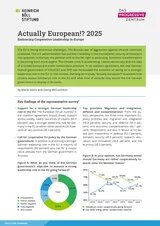
Actually European!? 2025

Published: 24 June 2025
Executive summary
A majority of citizens in Germany have a positive view of the new federal government‘s pledge for a stronger leadership role in the EU, but clearly advocate for doing so in a cooperative manner. These findings come from the latest edition of our long-term study 'Actually European!?' on Germany’s role in the EU.
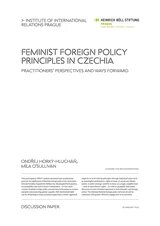
Feminist Foreign Policy Principles in Czechia - cover

Feminist Foreign Policy Principles in Czechia

Published: 24 March 2025
Discussion paper
Feminism faces prejudice in the Czech Republic. However, feminist foreign policy means more than just gender equality: principles like participation or accountability are already partly a reality here. How to move forward was explored through focus groups by researchers from the Institute of International Relations, Ondřej Horký-Hlucháň and Míla O’Sullivan, in collaboration with the Heinrich-Böll-Stiftung Prague.
Abstract picture accompanying the publication Small Modular Reactors for the Czech Market: An update - 2024

Small Modular Reactors for the Czech Market: An update - 2024

Published: 17 March 2025
The publication focuses developments in the field of small and medium modular reactors (collectively referred to as SMRs) in 2024 and builds upon the unique analysis "Prospect of Small Modular Reactors in the Czech Republic," published at the end of 2023. The author, once again, is emeritus Professor Stephen Thomas from University of Greenwich, London, with a chapter on the Czech context by Edvard Sequens from Calla - Association for Preservation of the Environment.

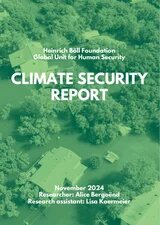
Climate Security Report

Published: 6 February 2025
Report
This report reviews climate security literature, identifies key players, and analyzes case studies. It highlights actors' needs in different contexts and offers recommendations for global, regional, and local engagement, with a focus on the global South.
Study on the state of the populist radical right and Hungarian influence building

Illiberal advance, but no breakthrough – yet?

Published: 28 January 2025
Study
Political Capital's study on the state of the populist radical right and Hungarian influence building, in cooperation with the Heinrich-Böll Foundation, aims to take stock of the "super election year" of 2024: how it has reshaped the scene for illiberal populist actors, and what it has brought to the Orbán regime in its efforts to build international influence and promote itself as a model of populism on the international stage.
cover_energy-communities.png

Energy Communities and the Legacy of Post-Socialism

Published: 19 December 2024
The energy and climate crisis is real, and the big fossil fuel companies are dictating the rules of the game. Global warming and Russia's aggression in Ukraine have accelerated the search for safer, cheaper, and greener energy. One option is energy provided by energy communities. In post-communist countries, however, cooperatives have a distinctly negative connotation. The belief that energy should come from big government agencies or fossil fuel companies has created a perception that energy prices are beyond our control. But is this statement true? We explore this and many other questions in the following report.

