


Analysis
After four years of war and efforts to sever energy ties with Russia, there is still one big gap: There is no replacement for Russian nuclear fuel, which the Czech Republic will buy until 2028. That money is ending up in a very dangerous place.

The European debate on dependence on Russian fuel has focused mainly on sanctions or bans on gas and oil imports for the past four years. Nuclear fuel, which is still imported from Russia, is left out of these discussions.
This applies to many European countries, including the Czech Republic. ČEZ, as the operator of two local nuclear power plants, has been looking for alternatives across the entire supply cycle for years, but the dependence on Russia still persists and will continue for another two years.
At the same time, Russia is trying to maintain its position in the EU market as a subcontractor through other companies. In addition to the continued vulnerability of the European energy sector to Russian whims, this has other security implications. The civil and the military nuclear programs in Russia operate under the same roof, so the money paid for civil fuel can be used by Russia to develop and produce nuclear weapons.
The purchase of nuclear fuel consists of a series of interconnected steps. In practice, the purchase of uranium, its processing, and its enrichment to the level required are each contracted separately, usually. The final stage is the production of the fuel itself.
The design and parameters of fuel assemblies vary depending on the type of nuclear reactor. In other words, fuel is always ordered for a specific type of power plant, and its history plays an important role. Nineteen reactors of Soviet or Russian design operate in the EU. The twentieth is about to be launched in Mochovce, Slovakia.
For some, there is already a replacement source of fuel available. However, in most cases (16 out of 20), the reactors are VVER-440 models. For them, the search for alternatives began in earnest only after Russia’s invasion of Ukraine four years ago. This also applies to Dukovany, where ČEZ is sticking to the plan that the old contracts with Russia will expire first before the transition to competition with other vendors, which will not transpire until 2028.
For the Temelín nuclear power plant, there is already a replacement source of fuel for the newer VVER-1000 reactors.
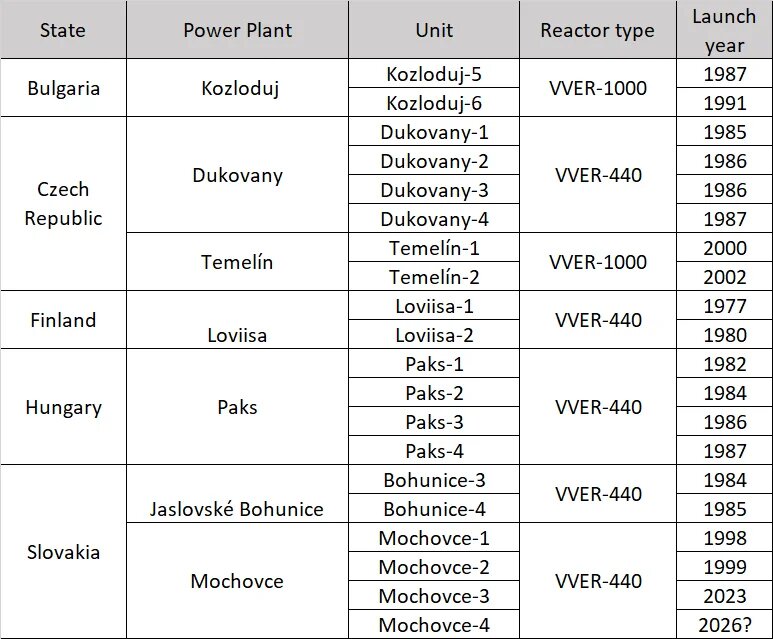
Diversification began in 2018, when ČEZ, as the operator, announced a tender for a new supplier, and in June 2022, two winners emerged: the Canadian-American company Westinghouse and the French company Framatome.
Westinghouse supplied fuel to Temelín for the first decade after it began operations. It was then replaced by the Russian company TVEL, but thanks to experience from the earlier relationship, there was still something to build on. Fuel supplied by Westinghouse returned to Temelín last May, and Framatome is due to join as a supplier this year.
Reactors of the type used by Temelín (VVER-1000 models) are also used in Bulgaria by the Kozloduy nuclear power plant, where the replacement process was similar. Westinghouse won the contract to supply one of the two Bulgarian units in 2022 and delivered the first fuel assemblies in 2024. The fuel for the second Bulgarian unit is to be provided by Framatome. Deliveries of Russian nuclear fuel to Bulgaria were terminated in 2025.
No alternatives and reliance on air transport despite the flight ban
While the VVER-1000 reactors were able to build on their previous collaborations with non-Russian suppliers, the situation was significantly more complicated for the VVER-440 reactors. At the time of the Russian invasion of Ukraine, there was no other fuel assembly manufacturer available for them other than the Russian state-owned company TVEL.
In order for the European operators of these reactors to avoid possible supply shortages, emergency supplies were agreed in March 2022. For this purpose, an exception was granted to the ban on the movement of Russian aircraft in the airspace of the European Union. The method previously used – rail transport via Ukraine – is not possible due to the ongoing conflict.
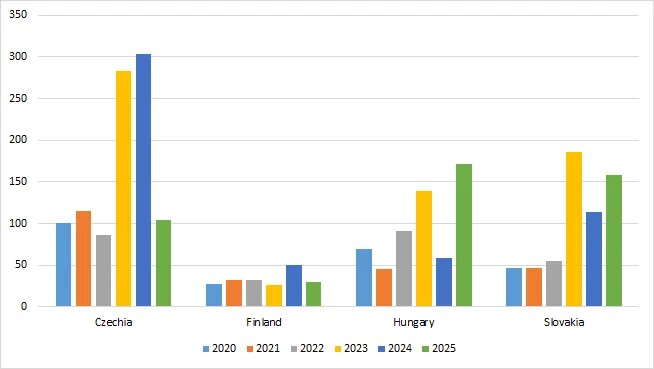
Russian fuel supplies to the EU peaked in 2023 (although not until 2024 in the Czech Republic), with the aim of pre-stocking for the future. According to the European database Acces2Markets, from the start of the Russian aggression until the end of 2025, Russian nuclear fuel worth a total of nearly €1.9 billion was imported, which corresponds to more than CZK 46 billion.
The Czech Republic was responsible for most of that, importing nuclear fuel worth 19.1 billion Czech crowns in the given period. Slovakia received supplies worth 12,6 billion Czech crowns and Hungary received supplies worth 11,3 billion Czech crowns. The ratio of the supply volume to the aforementioned countries approximately corresponds to the proportion of power produced through their local nuclear power plants.
Compared to imports of other energy-related raw materials, these are still relatively small amounts - from the outbreak of the invasion until the end of 2024, the Czech Republic imported oil from Russia worth approximately 138 billion crowns (EUR 5.6 billion). On the other hand, the Czech Republic sent more money to Russia for nuclear fuel supplies between 2022 and 2024 than the sum of the value of the humanitarian aid sent to Ukraine and the value of the military technology provided to Ukraine combined
Russian state-owned company TVEL, which receives these payments, is also part of the Rosatom consortium, responsible not just for the civil nuclear program, but also for the development, production, and maintenance of Russia's nuclear arsenal.

Photo: The Topol-M intercontinental ballistic missile was the first system of its kind developed in Russia since the collapse of the Soviet Union. The development and production of nuclear warheads for Russian weapons systems are provided by companies belonging to the same consortium as those supplying nuclear fuel to Europe.
The purchase of Russian nuclear fuel, therefore, not only supports the Russian war effort in Ukraine, which includes the repeated perpetration of war crimes against the civilian population, but simultaneously contributes to the combat readiness of Russian nuclear forces. Those are the same weapons, the use of which against Europe is regularly threatened by representatives of the Russian state.
At this juncture it is good to recall that the Czech Republic was added to the list of Russia’s enemies even before Russia invaded Ukraine. Russia undertakes hybrid operations on Czech territory today including, among other things, sabotage, arson attacks, influence operations or cyberattacks directed against civilian infrastructure and public institutions.
The Rosatom company is directly mentioned in relation to overflights by Russian drones of military bases in Western Europe.
The hasty search for substitute suppliers
The Finns were the first to start solving the problem of replacing Russian fuel for VVER-440 reactors. In November 2022 the Finns signed an agreement with Westinghouse following its previous supplies of fuel for both units of the Finnish Loviisa power plant between 2001 and 2007.
The first fuel assembly tests (still without uranium pellets) had been underway in Finland since 2023. In August 2024, the first “live” fuel arrived at the Loviisa-2 reactor. Formally, the Finns have a contract for Russian fuel supplies until 2030. However, if there are no unexpected complications with the American fuel, they may be able to get rid of their dependence on Russia before then.
Another matter is the nuclear fuel payments. Contracts for the supply of fuel assemblies are very often based on the take-or-pay principle. In other words, the customer is contractually obligated to pay even if he cancels or reduces his purchase. Since nuclear fuel is not yet subject to international sanctions, there is no way to terminate contracts already concluded due to force majeure.
Accelerated introduction of new fuel for the VVER-440 reactors will also be facilitated by the APIS program, co-financed by the European Union. The project is part of the Horizon Europe research and innovation grant and brings together a total of 12 partners, including ČEZ and the Řež Nuclear Research Institute.
ČEZ signed a contract for new fuel for the Dukovany reactors with Westinghouse in 2023. In June 2025, the first fuel assemblies arrived. Before they can be loaded into the reactor, they still need to obtain permission from the Czech State Office for Nuclear Safety. For now, it remains the case that Dukovany’s power production cannot do without Russian fuel.
The current contract with the Russian supplier was concluded until 2028. ČEZ describes its strategy as taking advantage of that contract not just for economic reasons (because it would have to pay them anyway), but also because the start-up of Westinghouse fuel production for Dukovany is phased until 2028 and the complete fuel consumption of the power plant cannot be ensured by Westinghouse before then.
In addition to negotiations with Westinghouse, negotiations are also underway with Framatome about supplies to Dukovany. However, unlike supplies to Temelín, no contract for Dukovany has been signed with Framatome yet.
Hungary, in 1999, concluded an agreement with Russia for it to guarantee fuel supplies throughout the entire service life of the existing units. Today, they are licensed until 2032 - 2037 (depending on how each unit was put into operation), but simultaneously they are working on extending those arrangements for another 20 years. Nevertheless, Hungary is trying to secure supplies of non-Russian nuclear fuel, too.
In October 2024, following up on a previous memorandum, the Hungarian operator signed a contract with Framatome according to which deliveries of new fuel for Hungarian reactors should begin in 2027. In November 2025 a contract was concluded between Hungary and Westinghouse, which committed to starting fuel deliveries from 2028.
Slovakia signed a contract with the Russian company TVEL in 1999 on fuel supplies until 2026, with a possible option for another four years after that. According to the available information, this option was exercised, so TVEL is to supply fuel to Slovak power plants until 2030.
Even so, in 2023 the operator in Slovakia concluded a contract with Westinghouse on future fuel supplies as well. In 2024, Slovakia concluded a contract with Framatome. The first fuel assemblies from that supplier are scheduled to arrive in Slovakia in 2027.
Is departure from Russian nuclear fuel within reach? It’s not so easy
So far, the focus has been on the supply of fuel assemblies intended for Soviet-designed VVER reactors. However, Russian imports also cover lower stages of the fuel cycle, such as the mining of uranium and its subsequent processing and enrichment.
The Russian import share in 2023 is shown in the following graph. These materials and services are used to produce nuclear fuel intended not only for reactors of Soviet origin, but also for power plants of Western origin.
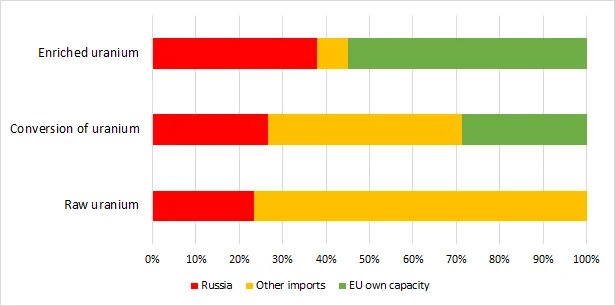
Given the existing alternatives, replacing natural uranium imported from Russia should not pose a major problem. Russia currently provides only around 6% of global supply. On the other hand, uranium mining in the EU ended in 2021 with the closure of the Crucea–Botușana Mine in Romania. EU countries are therefore fully dependent on foreign imports, with Russia’s share at 23%, according to the latest data from 2023.
In the case of uranium conversion and enrichment, Russia benefits from its existing infrastructure and its status as a traditional supplier. Russia currently provides about a fifth of global uranium conversion capacity and 46% of its enrichment capacity.
Full replacement of Russian supplies depends on expanding capacities i Europe and the US, which would require years of work and considerable investment. According to the Financial Times, new sources will not be fully available until after 2032.
Despite these efforts, however, Russia may not be completely eliminated from the market. One example is the planned production of fuel for the VVER reactors in Lingen, Germany, which is to be provided by a joint venture between Framatome and TVEL.
According to a statement from Framatome, complete fuel rods with enriched uranium pellets are to be imported from Russia and put into fuel assemblies in Lingen. The supplier of the resulting product will be Framatome, but production will depend on the Russian side, which holds the license and is to act as a subcontractor.
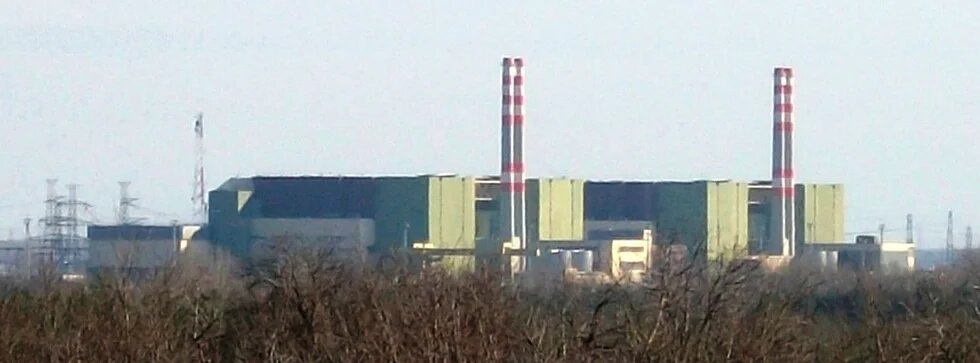
After Russia invaded Ukraine, Finland stopped its planned Russian-Finnish Hanhikivi nuclear power plant project, but Hungary is persisting still with a similar collaboration. Based on an intergovernmental agreement from 2014, two new reactors, each with an output of 1200 MW should be built next to the existing units of the Paks nuclear power plant. Their construction is being provided by Rosatom with financing provided through an interstate loan from Russia to cover around 80% of the costs.
Continued collaboration with Russian suppliers ultimately allows for Russian pressure on individual EU Member States and Russian influence on their foreign policy. This fact, together with the continued dependence on Russian imports, are the main reasons why sanctions on the import of Russian nuclear material began to be officially addressed by the European Commission only in May 2025 (and to a very limited extent as well). The approval of a single European framework that would address restrictions on imports of Russian fuels and technologies is currently hampered by the differing positions of the Member States.
If the Czech Republic does not want to expose itself to the risk inherent to this dependency, it should act much more forcefully towards Russian companies both at the domestic and the European level.
This text was written in cooperation with the Heinrich-Böll-Stiftung’s office in Prague and was published on Seznam Zprávy.


